


Dunkirk to D-day 5 day tours
A very popular 5-day tour is the Dunkirk to D-Day tour. We visit the Areas in Belgium around the dunkirk retreat, visit various locations from SS massacre sites to cassels, and then the Dunkirk beaches and areas it self.
Alternatively, for those traveling from London, the option of group travel via coach or a V Class Mercedes is available.
Next, as we traverse the channel ports of Dover and Folkstone, with a poignant crossing to Calais, France, the Dunkirk to D-Day battlefield tour unfolds. Throughout this voyage, we will emphasize the significance of the beaches of Dunkirk while unravelling the compelling history behind each stop.
Dunkirk: Miracle of Deliverance (May 26 – June 4, 1940)
- Operation Dynamo evacuated over 338,000 Allied troops—mostly British with large numbers of French—from the beaches of Dunkirk, France, across the English Channel to England.
- The rescue fleet included about 900 vessels, from naval destroyers to private “little ships.”
- Although Britain lost almost all heavy equipment, the operation saved the core of its army, allowing the nation to fight on.
2. Britain Stands Alone (1940–1941)
- After France fell, Hitler prepared to invade Britain (Operation Sea Lion) and launched the Battle of Britain, an air campaign to destroy the RAF.
- Britain’s new radar defenses, fighter production, and experienced pilots prevailed; by late 1940 the Luftwaffe had lost about 2,000 aircraft, twice the RAF’s losses.
- The victory, followed by the Blitz, proved Britain would not surrender.
3. Widening the War (1941–1943)
- Hitler turned east to attack the Soviet Union in 1941, diverting resources and easing pressure on Britain.
- The U.S. entered the war after Pearl Harbor (December 1941), joining Britain in a “Germany First” strategy.
- British and American forces gained experience in North Africa (El Alamein 1942) and the invasions of Sicily and Italy (1943).
4. Preparation for Liberation (1943–1944)
- Allied command under General Eisenhower planned the massive Normandy invasion.
- Deception operations such as Operation Fortitude convinced Germany the landing would come at Calais.
- By spring 1944 the Allies controlled the Atlantic, enjoyed air superiority, and had assembled the largest invasion force in history—over 150,000 men on D‑Day and thousands of ships and aircraft.
5. D‑Day: June 6, 1944
- Code‑named Operation Overlord, the landings on Normandy’s beaches (Utah, Omaha, Gold, Juno, Sword) opened the long‑awaited Western Front.
- Within weeks, over 1 million Allied troops were in France, beginning the drive that would end Nazi rule.
From Dunkirk’s retreat to D‑Day’s return, Britain transformed from a nation fighting for survival to the hub of a vast Allied coalition poised to reclaim Europe. This arc—desperation to dominance—is often seen as one of the most remarkable strategic recoveries in modern histor
Dunkirk Retreat
Operation Dynamo, the dramatic evacuation from the beleaguered port of Dunkirk, saw the daring rescue of over 338,000 British and French soldiers between the dates of 26 May and 4 June 1940. This monumental effort, often referred to as the "Miracle of Dunkirk," provided a much-needed surge of hope and morale to the British people amidst the dark days of war. However, Prime Minister Winston Churchill, ever perceptive of the shifting tides of conflict, recognised that despite this remarkable achievement, the most formidable challenge was still looming on the horizon, as Nazi ambitions now ominously turned their sights toward Britain itself.
The Dieppe Raid
At a tactical level, missions of this nature were designed to achieve specific goals, such as seizing advanced radar technology or obliterating critical drydocks. Strategically, commando operations generated significant media coverage, maintaining the United Kingdom's presence in the war despite its withdrawal from the European mainland. These daring raids compelled Germany to allocate more troops and resources to defend expansive territories, thereby granting the attacking forces a crucial advantage of surprise and operational flexibility. Launched on August 19, 1942, Operation Jubilee exemplified the continuation of these bold tactics. Notably, this operation marked the first time American troops would engage in ground combat on French soil, adding a momentous chapter to the unfolding narrative of the war.
D-Day American Sector Normandy
In the American D-Day sector, which spans approximately 50 miles from Caen—the primary objective in the British sector—strategic efforts focused on securing vital beachheads and establishing a foothold in Normandy. This area was marked by fierce resistance, as Allied forces encountered well-fortified German positions. The successful capture of key towns and roads was crucial for facilitating subsequent advances inland and ensuring the flow of reinforcements and supplies. The American forces aimed not only to secure these beachheads but also to connect with their British and Canadian counterparts, ultimately paving the way for the liberation of occupied France.
82nd Airborne
The 82nd Airborne Division was tasked with critical missions during World War II, specifically involving the landing zones designated N, O, and T. Their objective was to capture the strategic town of Sainte-Mère-Église and secure the La Fière bridge. These locations were crucial for establishing a stronghold and defending against the expected German counterattacks, which were anticipated to occur shortly after their landings. By securing these drop zones, the 82nd Airborne aimed to disrupt enemy movements and ensure the success of the Allied forces in the region.
101st Airbourne
On June 6, 1944, the American 101st Airborne Division executed a critical airborne assault over Normandy, landing at locations designated as A, B, and D to secure key areas around Utah Beach. Their mission was to disrupt enemy defenses and facilitate the Allied forces' beach invasion. As the paratroopers descended into the darkness, they faced strong winds and flak, leading to scattered landings. Despite the challenges, they quickly organized themselves to neutralize German positions, cutting off supply lines and gathering vital intelligence, all of which proved essential for the success of the D-Day operation.
Utah Beach
One of the designated landing zones for the Allied invasion of Normandy was stormed by the 4th Infantry Division on June 6, 1944. The division faced relatively light casualties compared to other landing sites, allowing them to quickly press inland. Their objective was to capture the strategically important town of Saint-Lô, which served as a vital route for further operations in the region.
Omaha beach area
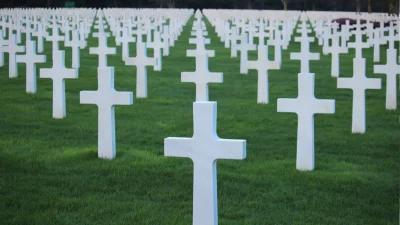
Omaha Beach is the code name for a heavily defended landing zone in Normandy, France, where American forces faced intense German resistance during the D-Day invasion on June 6, 1944, on a sea-borne attack. resulting in the highest Allied casualties of the day. Today, it's a poignant memorial site with bunkers, monuments and museums, and the Normandy American Cemetery, commemorating the bravery and sacrifice of soldiers who landed there to begin the liberation of Europe.
The Omaha Military Cemetery
It is a significant resting place that accommodates approximately 9,000 graves, honoring those who have served in the military. It stands as a solemn tribute to their service and sacrifice.
British Sector
On D-Day (6 June 1944), the British were responsible for the eastern sector of the Allied landings during Normandy landings. This sector included two main beaches:
🇬🇧 British Sector Beaches
1. Gold Beach
- Assaulted by the 50th (Northumbrian) Infantry Division
- Supported by the 8th Armoured Brigade
- Objectives:
- Capture the town of Bayeux
- Link up with American forces from Omaha Beach
- Outcome: Successful advance inland; one of the more effective landings
2. Sword Beach
- Assaulted by the 3rd Infantry Division
- Supported by 27th Armoured Brigade
- Objectives:
- Capture the city of Caen
- Link with airborne troops and Canadian forces at Juno Beach
- Outcome: Strong initial success, but advance slowed before reaching Caen
🪂 Airborne Forces (Eastern Flank)
To protect the British sector’s left flank, airborne troops landed overnight:
- 6th Airborne Division
- Key missions:
- Capture Pegasus Bridge
- Destroy bridges over the River Dives
- Hold off German counterattacks
Nearby Allied Sector
- To the west of Gold Beach was Juno Beach, assaulted by Canadian forces.
Summary
- The British sector = Gold + Sword beaches
- Supported by airborne troops securing the eastern flank
- Faced moderate to heavy resistance, but achieved most early objectives
- Crucial in establishing a foothold in Normandy
The British sectors for D-Day were primarily with airborne landings at Pegasus Bridge, part of the wider British Second Army's objective to capture key towns like Bayeux, Arromanches (for the Mulberry Harbour), and link up with British & Canadian forces on Juno Beach. British on Gold Beach was split into sectors (How, Item, Jig, King), facing tough German resistance in areas like Jig (La Fontaine Saint-Côme to Asnelles), but British troops achieved a significant inland advance by day's end, linking with Canadians
Pegasus bridge
The small force of 181 men was commanded by Major John Howard and joined with a detachment of Royal Engineers who landed at Ranville-Benouville in six 28-man Horsa gliders. Having taken off from Dorset, the gliders were towed across the Channel by Halifax Bombers. With perfect navigation and piloting skills, the gliders landed on time and on target within a few yards of each other. Major Howard’s glider landed within a few feet of the canal bridge. The bridge was captured after a fierce ten-minute firefight, the action all over by 00:26, a full six hours before the beach landings.
Hillman battery
The Hillman Battery, (Widerstandsnest 17 or WN 17) was very heavlly fortifited germ bunker complex ocerloking Sword beach normandy, a crucial part of the Atlantic Wall, which significantly delayed the British 1st Suffolk Regiment on D-Day despite being heavily bombarded, forcing a tough, prolonged assault before it finally fell on June 7, 1944, delaying the push to Caen and becoming a significant symbol of German resistance,
Main Assault Force Juno Beach Canadian Force
- 3rd Canadian Infantry Division
- Supported by the 2nd Canadian Armoured Brigade
Objectives
- Capture coastal towns like Courseulles-sur-Mer
- Push inland toward Caen
- Link up with:
- British forces at Gold Beach (west)
- British forces at Sword Beach (east)
What Happened
- The Canadians faced heavy German resistance, including:
- Strong beach defences
- Mines and obstacles
- Rough seas delaying the first wave
- Initial landings were difficult, with high casualties in the first wave
Outcome
- Despite resistance, Canadian forces:
- Broke through German defences
- Advanced further inland than any other Allied force on D-Day
- However, they did not fully reach Caen on the first day


